#13: Sustainability: An Essential Element of Long-Term Strategy
“Sustainability is the thread that binds an organization together and without it, an organization risks becoming segmented.”
RESOURCE RECOMMENDATION:
Download our Free Facilitation Activity: The Thread That Binds
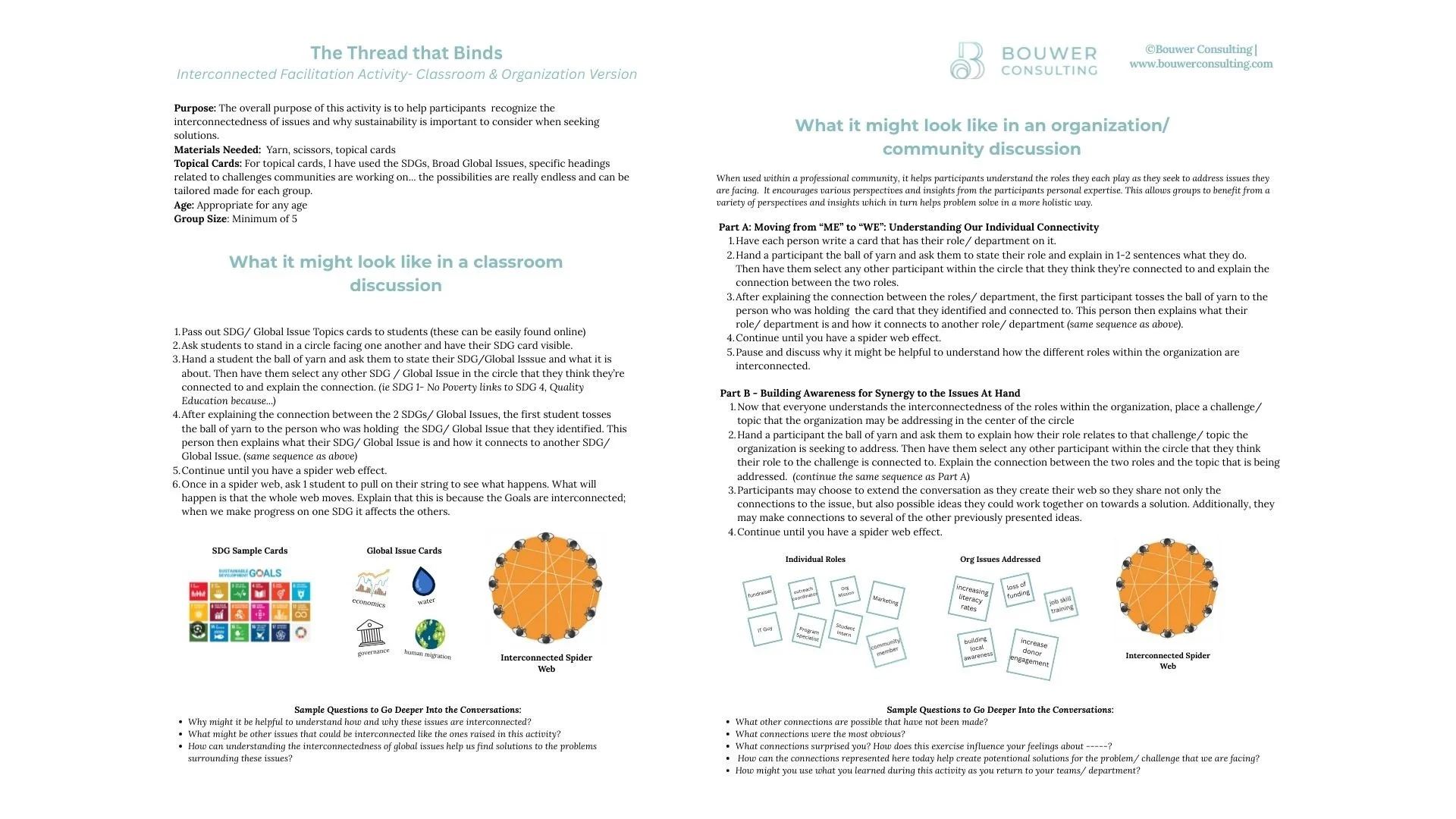
Synopsis: Whether you’re an educator in the classroom or facilitating a workshop for adults around organizational development, this activity, “The Thread That Binds”, helps participants recognize the interconnectedness of issues and why sustainability is key when seeking solutions.
Over the past month I have had several conversations with various NPOs and something I have begun to notice is that for many, there has been a disconnect between their vision and mission and the programs that they offer. At first I thought this was an anomaly, but by the fifth conversation I began to see a pattern.
For many, while the organization’s vision and mission were there, in reality they were less interested in meeting the objectives that the organization was created for. Funding was limited and so, consequently, they tended to change their initiatives based on various funds available whether or not the programs or services were aligned with their organization’s vision. As a result, it was often unclear what their main focus was and how the programs they offered related.
Many cited that funding was a challenge, especially with many cuts made via the cancellation of the USAID and fierce competition for limited resources, so the focus was on getting funding in whatever way possible.
Based on what was being shared, in each of the conversations I asked about sustainability practices, specifically to programming and funding without compromising an organization’s vision. What struck me throughout these conversations were the number of times I heard that while sustainability was something they knew they should consider and perhaps look into implementation, in reality it was easier to just ask for donations, fundraise, apply for grants, and continually shift programming.
One organization even went so far to explain that it was easier to go hat in hand and ask for a handout than to change their current practices because that would be too much work and they had limited capacity.
This was definitely a shift in mindset for me as sustainability is often a core tenant for many NPOs in the west. However, as I probed these ideas a bit more, what began to surface was that many of the organizations did not have a clear understanding of what sustainable practices were or how they are beneficial, both short and long term for their organizations.
What is Sustainability?
When asked what sustainability was, most people automatically think about the environment- and they wouldn’t be wrong to think about that. Environmental practices are something that I think as a global society we have done a lot of work around in regards to informing, teaching, and using what we know to guide the decisions we are making. In fact, a common refrain I heard when asked about sustainability was something such as, “yes, we are committed to sustainable eco-practices but our focus isn’t environmental per se”.
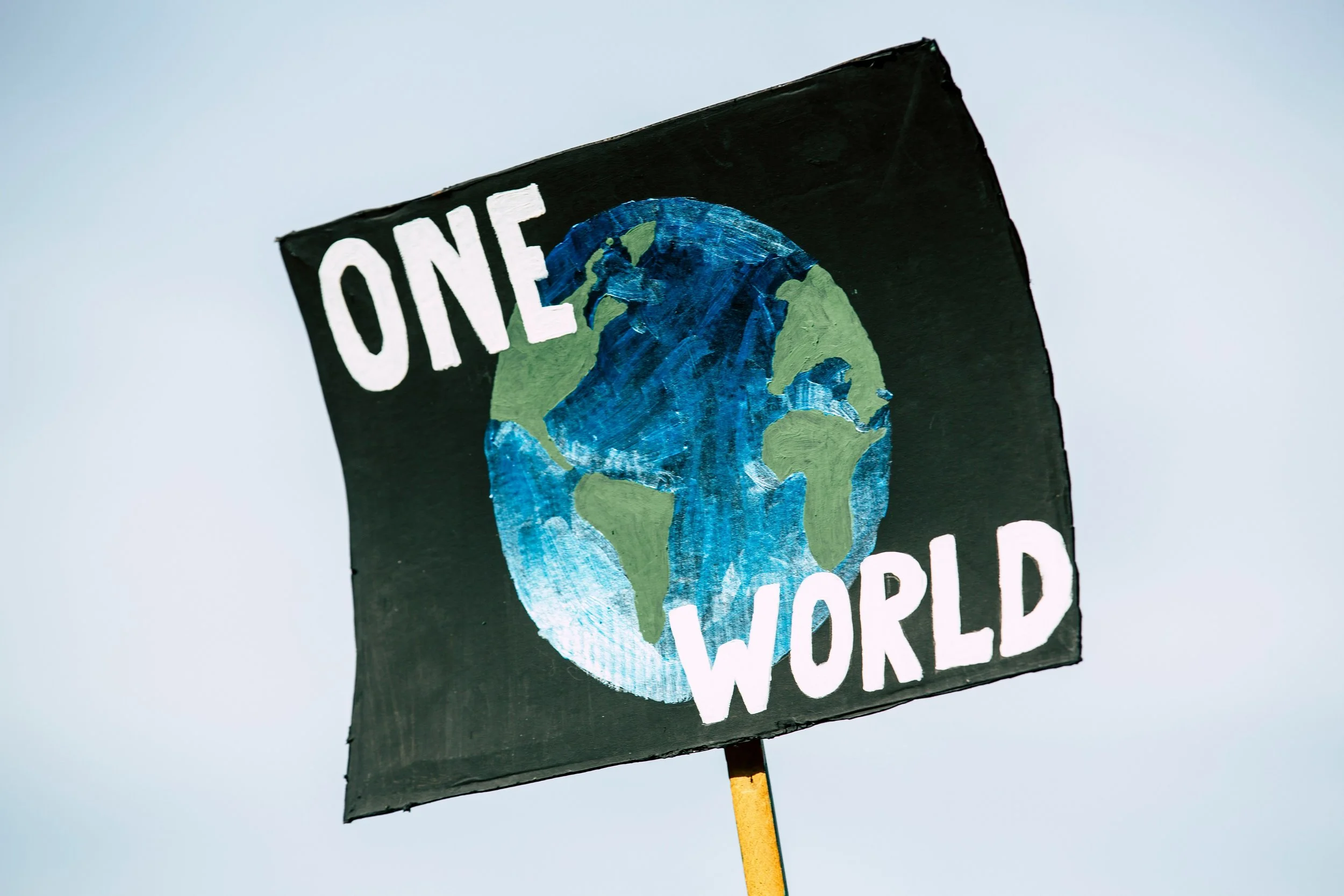
Yet, as a believer in systems thinking and the interconnected nature of things, I believe sustainability is much more than this. It impacts every aspect of an organization from the initial vision of the organization’s conception, its governance, funding, the implementation of programming, to the communities one is partnering with, etc. Sustainability is the thread that binds these things together and without it, an organization risks becoming segmented.

#13:
Sustainability: An Essential Element of Long-Term Strategy
So what is sustainability if it’s more than eco-friendly practices?
In the simplest definition I would share with students is that it is a framework in which we must consider the following factors- environment, society, and economics- holistically, as we make decisions to meet the needs we have WHILE AT THE SAME TIME also keep the bigger picture (the future we desire) in mind.
It’s about looking at the long-term and not being willing to trade it off for short term gains or profit. And yes, while that may seem daunting and to some may feel near impossible, it’s about reframing how we look at situations and the challenges that we face.
By seeking to find the common ground and begin from there, interests within an organization do not have to complete- rather, the key is to find common ground and build from there.
(Some research includes a 4th factor, culture; however, that could be a subheading under society)

Why Does Sustainability Matter For an Organization?
When you begin to look at an organization in a holistic manner, one outcome is that it demands transparency. Returning to the idea of sustainability being the thread that connects everything together, when that thread is pulled on one domain, due to the interconnected nature, it ripples across an organization.
Consequently, there is a lot more care and thought put into decisions as by nature it begins to create the guardrails of accountability.
In turn, this accountability develops trust on multiple fronts- donors, government orgs, community stakeholders, the public, etc. Additionally, this transparency and accountability provide the foundation for open communication between the organization, donors, and stakeholders.
Secondly, when an organization begins to implement sustainable practices and solutions, it provides clarity for what they stand for. Instead of swaying with popular trends, organizations are able to be consistent in their objectives and the implementation of their vision. This in turn cycles back to trust- donors, communities, and the public know exactly what organizations stand for and that they stand by what they say they will deliver.
Thirdly, it encourages organizations to think long-term. The world we live in is constantly shifting and can be unpredictable, particularly in funding. When organizations begin to think about sustainable practices, especially when it comes to funding, they begin to shift from the present to considering more long-term strategy.
Many NPOs I spoke with spoke of the need to prioritize immediate needs over sustainable growth. Yet, when you begin to think about an organization from a holistic approach, space is provided for ideas to begin to percolate about how to diversify funding and revenue opportunities that align with the organization’s core mission and values instead of relying on one or two main sources.
It also encourages organizations to stay ahead of trends, emerging technology, as well as invest in capacity development which helps the organization be as effective as possible.

Final Thoughts…
The NPO sector isn’t the only sector that struggles with the idea of sustainability. I’ve noticed it in educational institutes as well; as circumstances change there is often a scramble to focus on the “right now” vs the long term.
Instead of a holistic approach, there becomes a focus on one factor, usually economics, that drives decision making; along the way, staying true to the vision and mission of the organization begins to become secondary. Clarity gives way to lack of transparency and consequently accountability and trust begins to falter.
Yet it doesn’t have to be this way- in fact, sustainable practices provide opportunities for both current needs to be met and long term vision to be worked towards. Making sustainable changes within an organization doesn’t require a complete restructuring of an organization overnight; it does however require intentionality.
By making a conscious commitment to view various elements of an organization from the lens of inter-connectivity and using sustainability as the thread that binds them together, common ground can be found. From there system changes can begin to be implemented, thus creating a longer lasting, mission driven organization.
If your organization is looking for ways to create sustainable solutions for challenges they may be facing, we’d love to connect and explore how we can assist you.
