
#23: From Opinions to Evidence: Six Strategies for Building Thinking Practices in Our Teams
“We need to have the willingness to question assumptions that are made, evaluate evidence as we come across it, and consider that there are alternative perspectives (and many of those alternative perspectives are valid!) instead of just accepting information we consume at face value.”
RESOURCE RECOMMENDATION:
Synopsis: Click for a free PDF download of the 6 strategies that individuals and teams can use to guide them to develop critical thinking & systems thinking.

There’s a massive crisis taking place in our world today and it is around the ability to discern what is real information, to analyze the information we are continually subjected to 24/7, and to critically and analytically think about the information that we are engaging with.
I truly believe that these are vital skills that we should all be practicing, now more than ever. The ability to critically think encourages us to objectively analyze, evaluate a topic or issue at hand, and then form a reasonable judgement about it.
To do this though, we have to be able to actively question what is around us. We need to have the willingness to question assumptions that are made, evaluate evidence as we come across it, and consider that there are alternative perspectives (and many of those alternative perspectives are valid!) instead of just accepting information we consume at face value.
We need to have the willingness to question assumptions that are made, evaluate evidence as we come across it, and consider that there are alternative perspectives (and many of those alternative perspectives are valid!) instead of just accepting information we consume at face value.
Years ago I read Nick Cohen’s book, You Can’t Read this Book, Censorship in an Age of Freedom and in the opening chapter he referenced the English Philosopher, John Stuart Mill’s work, “On Liberty”, and his perspective for the need of critical thinking and diversity of ideas. It it, he argues that when we suppress different views or perspectives and base our assumptions on the idea that they are infallible (unable to be wrong), we actually begin to see intellectual stagnation, which ultimately is what turns a belief into a dogma (an idea seen as an absolute truth).

#23: From Opinions to Evidence: Six Strategies for Building Thinking Practices in Our Teams
This idea has always stayed with me, especially when I worked directly with students. One of the most meaningful exchanges I had with a student when I was an instructor for a vocational education program and the course I was teaching was Global Studies. One late evening this student came to my office and said something to the effect that he needed to apologize. Taken aback, I asked for what reason as I hadn’t noticed anything out of the ordinary.
His reply was along the lines of:
“The last few months I have sat in your class and continually thought, how is this even helpful? This class is a waste of time, nothing here is really related to the job I intend to do- until tonight.
I realized this course wasn’t really about the different topics you were teaching, you were actually teaching us how to think. It is actually about the questions we ask which encourage us to understand more deeply, begin to see patterns, and more importantly, that there can be more than one solution which we can only see when we begin to engage with different perspectives. This class is actually a thinking class.”
That’s a big ‘aha!’ moment for any student and his earnestness and willingness to come share that moment is one I will forever be grateful for.

How do we develop critical thinking, in addition to a systems thinking approach, that begins to come naturally?
How do we develop critical thinking, in addition to a systems thinking approach, that begins to come naturally?
As an educator, this is a question, or a derivative of one, that I have often fielded from parents. Fellow colleagues and I often brainstormed opportunities and sought best practices for how we could continually build these skills into our units of study and provide students opportunities to practice various thinking routines.
There’s a strong need for critical and analytical thinking, and even the World Economic Forum places critical & analytical thinking in the top skills necessary moving forward by 2030.
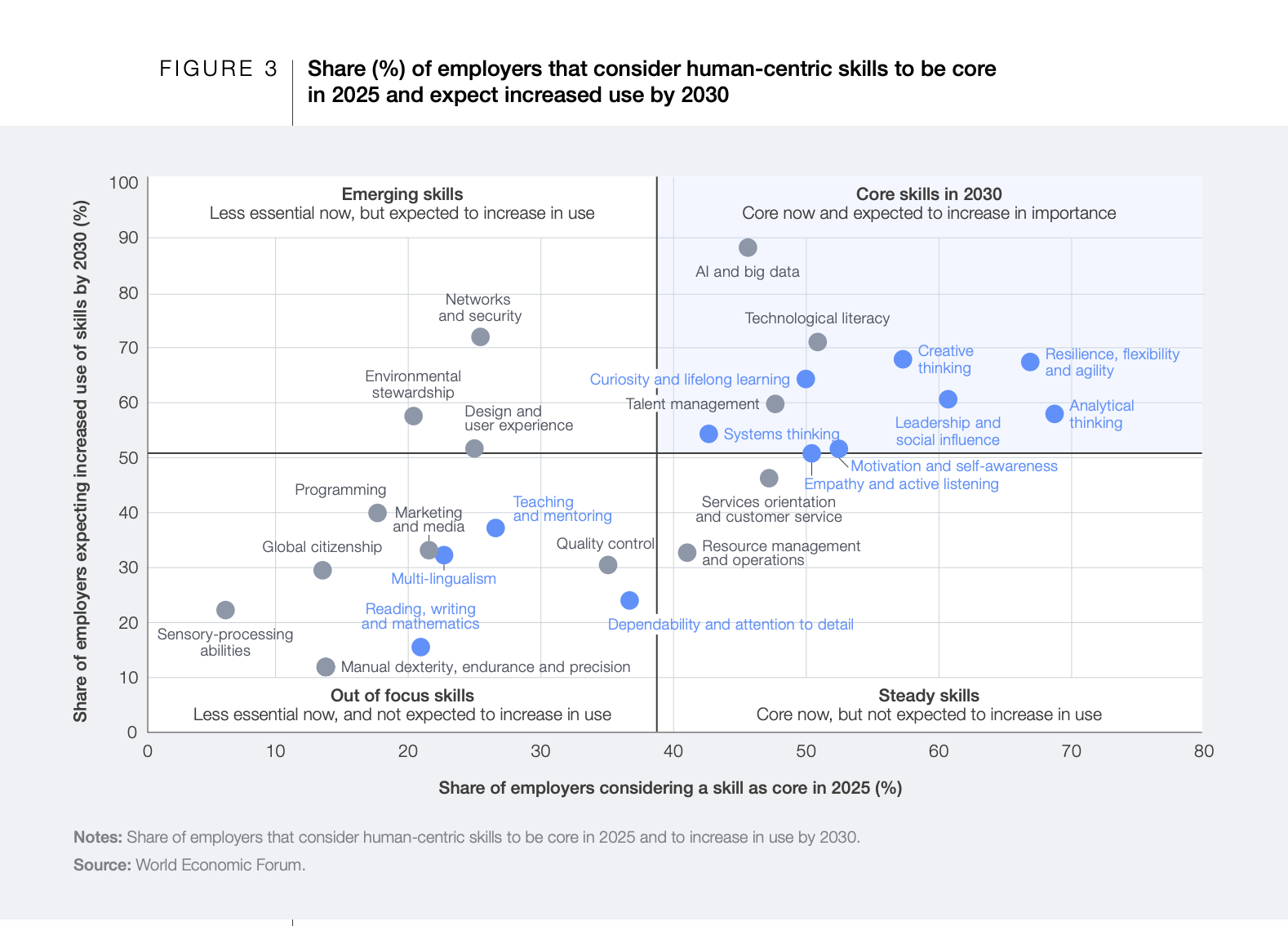
The top right quadrant shows that critical thinking, analytical thinking, and systems thinking are all rising in need by 2030.
Source: The Word Economic Forum
Below are a few suggestions to build not just critical & analytical thinking, but also begin to encourage systems thinking.
These are skills and strategies that I use not only in my own life and with clients, but also what I used as a classroom educator.
6 Strategies for Building Critical Thinking & Systems Thinking
1. Visual Modeling
Visual modeling helps to make sense of/ or explain a complex situation. Often, once visuals are used, new insights tend to be revealed.
Whether I work with students, clients, or even in my own day-to-day problems I might come across, I ask: Can you draw or illustrate this situation with a diagram, metaphor, relationship, or symbol?
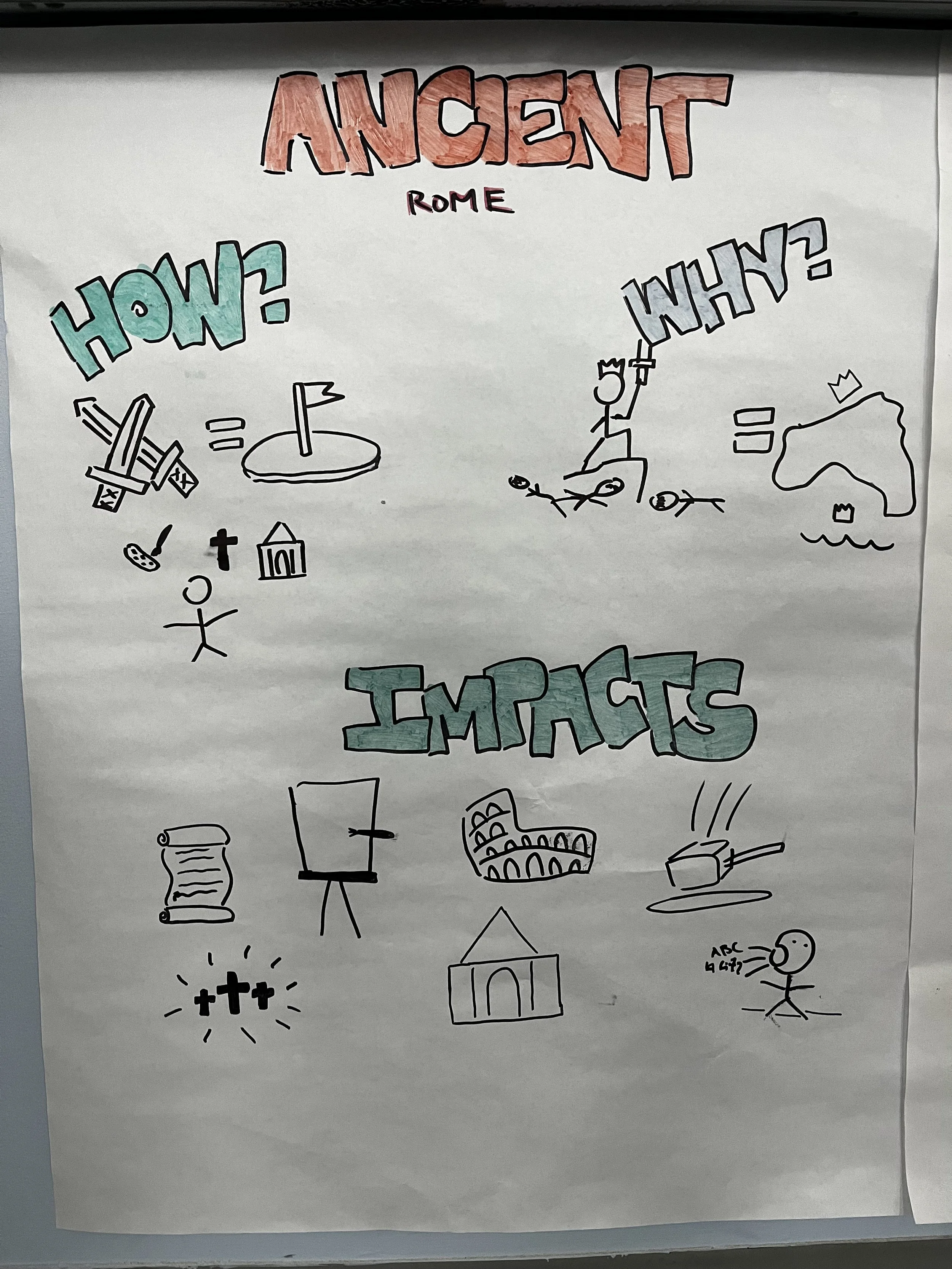
An example of using ‘visual modeling’ illustrating why Ancient Rome was influential
2. Looking for Connections
To gain insights about the whole, looking for connections and relationships between parts is key.
Questions I often ask:
What do we see?
Which parts have a connection? How might these parts be connected and what might this tell us about their relationship?
Based on the connections we see, is there an emerging or recurring pattern?
How might that pattern impact the whole?
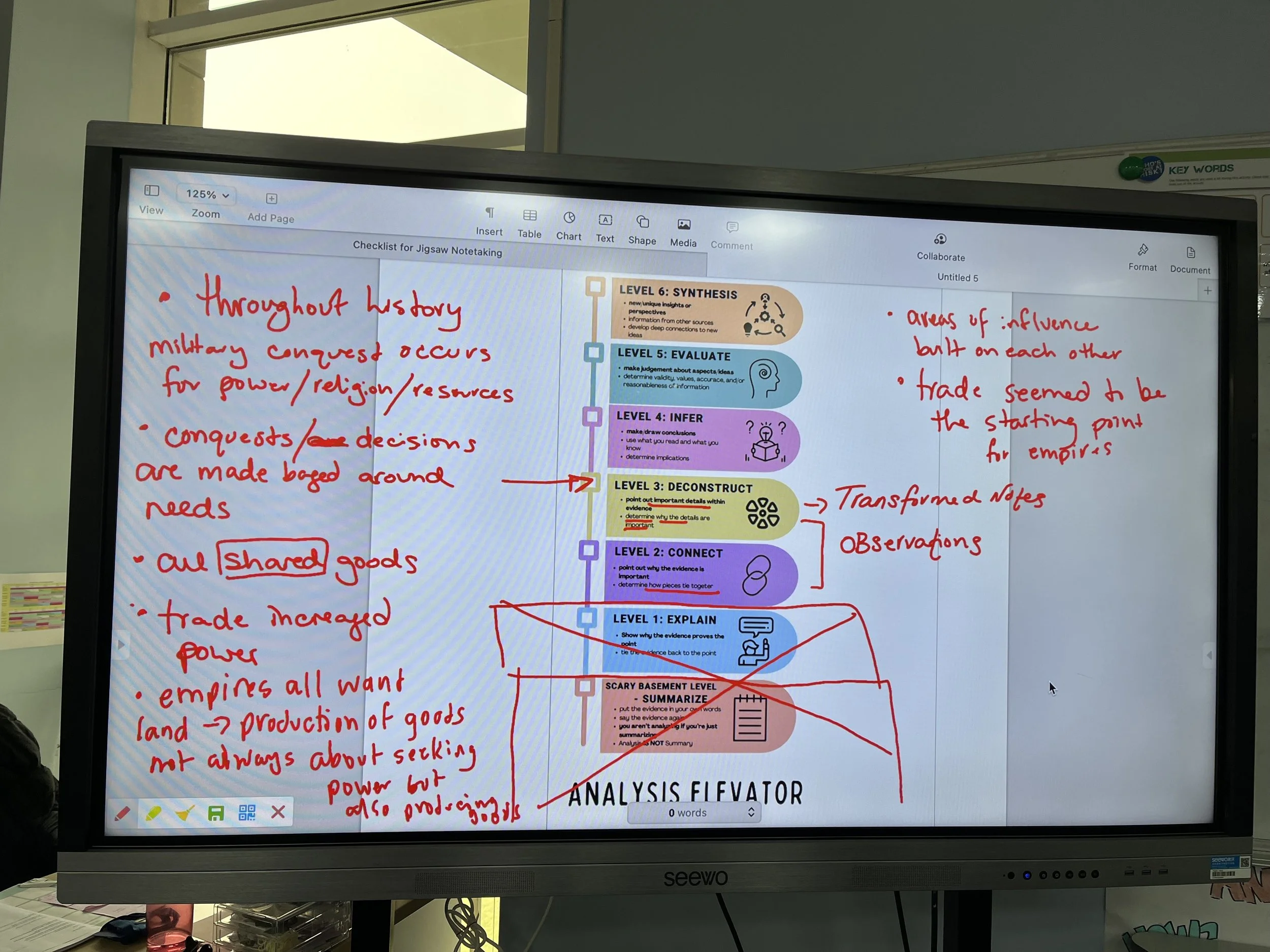
After looking at different civilizations and periods in history, connections, patterns, and changes were identified as students sought to define the concept of globalization through history
3. Engaging in Diverse Perspectives to see a situation from different vantage points.
This is a key skill to develop, particularly with young people. The earlier you begin to practice this skill, the more natural it becomes.
As an educator teaching Social Sciences, I would often take a topic and have students engage with it from various lens- historical; geographical; economics; civics; societal- the reason for this was because depending on the circle one is standing in, different aspects would be heightened. Therefore, by looking at a topic from multiple dimensions, students could see how each domain impacts one another.
The same is true for teams and companies for projects they may work on and challenges they may face; as discussed in several posts, no team is an island.
Questions I often ask:
What beliefs or values are informing how I see, engage, and react to the situation or information I’m presented with?
What might be different perspectives related to this situation?
Who might have a different perspective from my own on this situation?
How might they see it and what might influence their perspectives?
Whose voice is not being heard and why is it not heard?
If that silent voice was added to the conversation, how might the conversation change?
4) Listen Deeply & Challenge Assumptions
Engaging with different perspectives isn’t enough. Previously, in the prior post “The Importance of Active Listening”I talked about the difference between hearing and listening. If we say we are willing to engage with different perspectives, that indicates that we are open to doing two key actions:
Being present in the moment and listen deeply to what is being said
Are willing to question assumptions we might have as they surface to determine if they are true or not
Questions I often ask:
Am I critically listening to deepen understanding, or just waiting to talk and make my point?
Am I suspending judgement and biases as the alternate position is shared?
What assumptions am I making about this situation and the other position?
How am I demonstrating that I am open to engaging with new information?
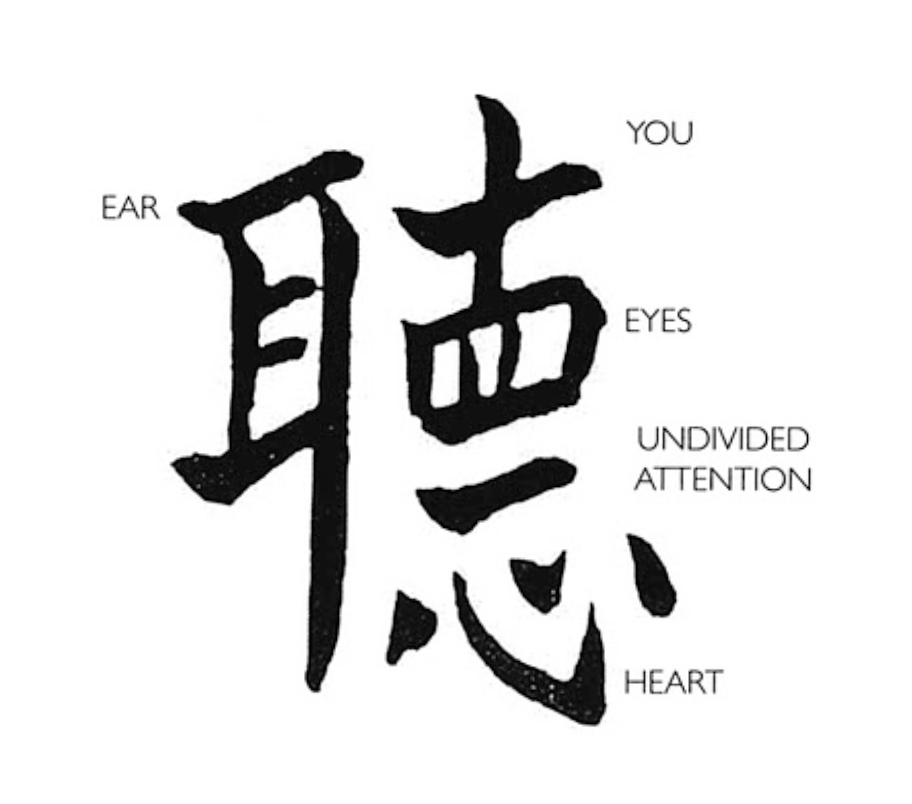
I have always loved the Chinese character ‘to listen’
5) Uncover Unintended Consequences before committing to a decision or action
This is a key skill and is helpful when making simple decisions such as joining a sports team, to more significant decisions like moving for a new role or implementing a new company initiative. Check out our post, “Intentionality”where we discuss how intentionality is key for decisions we make.
Questions I often ask:
How might this decision move us closer to or further away from our goal or desire?
What else might happen if we do this?
What adaptations or adjustments might be necessary to make?
6) Regular Reflections
Taking time to regularly reflect on a situation not only allows us to draw deeper learning, but also interpret the outcomes which can be used as guideposts for the future.
Reflection doesn’t always mean writing things down. It could come from having a conversation with a colleague, drawing a sketch note, creating a bullet list, or leaving yourself a note on the side of a document. There a lot of ways reflection can take place, the important aspect is that it is not overlooked.
Questions I often ask:
What did I intend to happen and what actually happened?
What does it tell me about the situation or system?
How do I work with and use this new insight as I move forward?

Final Thoughts…
Critical/ analytical thinking skills and being able to recognize how a system interacts does not occur overnight. It requires intentional practice.
Just like having a healthy body requires intentional practices and habits, ie. going to a gym, eating balanced meals, alternating strength training and cardio, the same is true for these skills.
Small repeated practices, slowly build the skills necessary. These can be incorporated into your daily routine and team interactions. As you continue to practice these strategies, you will find that in time, not only does your understanding of complex situations deepen, you also begin to see how the system and its parts interact with one another. By incorporating these strategies, you become much more effective in your decision making.
If you or your team would like to begin incorporating these strategies into your processes, I’d love to facilitate your conversations! To learn more about what we can do, visit “Our Offerings” or schedule a free, 30 minute introduction call.
