
#17: Transforming Perspective: Moving From Linear Thinking to Systems Thinking
“The process of gaining deeper understanding isn’t linear- often as we deepen understanding in one area, a new layer of awareness rises in another.”
RESOURCE RECOMMENDATION:
Watch Now:
Synopsis: In this 9 minute TEDx Talk, Petri Uusikylä, a research director at the University of Vaasa, Finland, explains why we should be looking at our world, and the events that are unfolding, through a broader systems lens- seeking out the patterns and relationships instead of viewing things in isolation.
This weekend I had a wonderful opportunity to participate in a Climate FRESK. A FRESK is basically a climate workshop in which groups work together to arrange a variety of cards based on the IPCC report to map out cause > effect relationships related to climate change and challenges we are facing. The goal is to not just deepen understanding around climate issues, but also to engage in a healthy discussion about potential solutions individuals and communities might do to lower their carbon footprint and encourage more sustainable lifestyles.
Yet, as I was participating throughout the workshop and listening to conversations, my internal thoughts continued to tumble around several questions:
“Why was this being mapped in a linear, cause > effect relationship?”
“What might happen if we were to change from linear thinking to include the larger system as well?”
Traditional Linear Thinking
Often times when we think about ideas, problems, or challenges that we face, we tend to lean towards linear thinking. For those that enjoy analogies, it’s often like a road trip- we start at A, pitstop at B, and end at C.

This type of thinking tends to be very cause & effect oriented - we see a problem, we seek out a solution. For example, in an education setting we might see that classes are starting to be overcrowded so we officially increase class sizes or a new section might be opened. In NPOs, a program might see that a community is struggling with high unemployment. Their response might be to offer job skill training for individuals as a way to lower unemployment.
Often, in linear thinking, the focus is on isolated situations or problems. In fact, this tends to be the default thinking that most organizations fall back on because from a young age, children are taught that every action has a reaction. Therefore, we tend to simplify things so that it fits into this model of thinking.
The challenge with this type of thinking is that it is very narrow. In an effort to fit everything into the contextual box that we have designated the problem to go into, we actually ignore the broader, more complex system and how the moving parts impact one another. Often, when we use linear thinking, it encourages us to believe that everything we need to know or understand falls into a cause > effect, action > reaction model. Yet in reality, organizations and their offerings are much more complex.

#17:
Transforming Your Perspective: From Linear to Systems Thinking
The Fresk
Returning to the Climate Fresk that I was participating in, as I listened to different fact cards read out and to various perspectives for why cards should be placed in a particular order, I took a step back and thought: in order to to talk about climate causes, factors such as social, geographical, political, and even past also had to be considered. All of these are part of the broader system and interconnected. Therefore, one cannot separate climate out and seek real sustainable solutions if we aren’t willing to acknowledge and address the other interconnecting factors as well.
Therefore, in my mind, attempting to make a linear map with 30+ cards was not feasible because there were so many additional systems and feedback loops that connected to one another and should be taken into consideration at the same time.
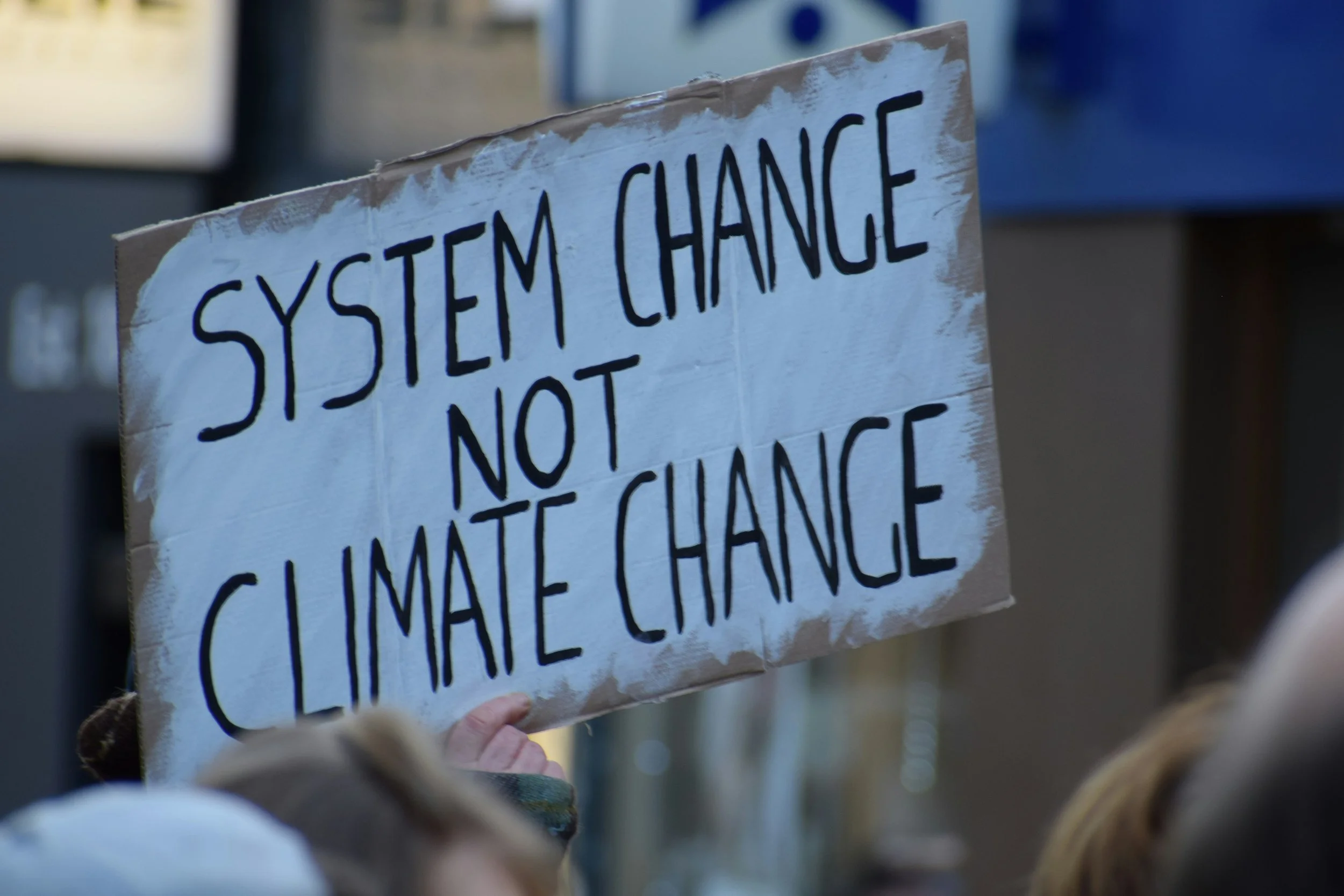
Why We Need Systems Thinking
Systems Thinking is not a new idea. In fact, it’s been around for decades and is one that while we often say we understand, in practice it is often less considered.
Systems Thinking is really about the larger, broader perspective instead of just a small part. It emphasizes the need for considering the relationships and dynamics between systems that are found within the whole system.
In an organization, Systems Thinking encourages individuals and departments to move away from an ‘us’ vs ‘them’ mentality and pushes the boundaries in our thinking. Instead of considering things in a siloed perspective- ie:‘marketing’ vs ‘fundraising’ or ‘admissions’ vs ‘faculty’- we are moved to think in a broader aspect. We are all part of the same system and therefore together responsible for the problem and the solution.
However, Systems Thinking also goes much deeper than just mapping out an organization, key stakeholders, and their impact on one another. It seeks to understand not just causes, but the deeper factors that connect to the causes. It is especially dynamic when either a problem continually persists over time, or people have attempted to solve the issue in the past.

The process of gaining this deeper understanding isn’t linear- often as we deepen understanding in one area, a new layer of awareness rises in another.
Since systems thinking is a model of analysis that includes formal and informal interrelationships, it focuses on the process and becomes incredibly helpful in differentiating an underlying issue vs symptoms of something deeper. As a result, it often has a feedback loop as it seeks to find sustainable solutions.
Don’t Throw Out Linear Thinking- Yet
This doesn’t mean that linear thinking should be dismissed. Linear thinking tends to focus on one part of a larger system, like a small snapshot of the bigger picture. There are times when knowing the larger, fuller system’s information is not needed and as a result, linear thinking is much quicker when a decision is needed to be made.
For example, during rainy season in South East Asia, I may need to know if there is rain scheduled for today to determine if I should pack an umbrella. While there are many factors that may play a role in whether rain will occur or not, I don’t necessarily need all that information.
In this instance, I don’t need all the factors of the system: atmospheric pressure, humidity levels, barometer readings, etc- to be able to plan and out-think the weather; I just need to know if I should put an umbrella in my bag.
Additionally, there are times when having too much information can lead to decision paralysis. So much time may be spent on analyzing, that moving forward seems to stall.
As such, there is a time and place for linear thinking.

However, for organizations to be at their best, systems thinking needs to also be actively incorporated into their thinking process.
Final Thoughts…
For many organizations, including NPOs and educational institutions, embracing and practicing systems thinking reveals the intricate web of interconnectedness in their work. By fostering this mindset, teams enhance collaboration in problem-solving and create authentic pathways for meaningful growth and sustainable success. This approach not only strengthens capacity to address complex challenges, but also cultivates an environment where innovative solutions can develop.
And my final thoughts for the Climate Fresk- it’s a great tool for students and adults to initiate broader conversations for what is going on in our world today. If there’s a Fresk being hosted in your area, it’s worth trying out!
