#20: Breaking Down Silos pt 2: The Power of Interconnectedness
“In Systems Thinking, the dialogue that is encouraged often breaks down barriers and walls so that there isn’t one specific ‘keeper of knowledge’. Rather it becomes a collective well of information that all can draw from.”
RESOURCE RECOMMENDATION:
Synopsis: Designed for ages 10+, this activity could be used in a classroom setting, as team building, or with program participants to help provide an interactive visual for how domains in life are interconnected and dynamic.
This also provides a platform for discussing open and closed systems and what takes places when different types of information are fed into the system.
In part one, we talked about the importance of collaboration. For collaboration to be truly powerful though, three elements must be in motion at the same time:
effective communication
trust
active listening
These three elements, when woven together, begin to not only impact direct teams, but also has a broader impact on the organization as well. Often, is these teams which utilize Systems Thinking as they build their collaboration skills.
How Systems Thinking Breaks Down Silos to Foster Collaboration
In our blog post, “Decoding Complexity: How Systems Thinking Transforms Our Approach to Challenges”, we shared several positive, broad benefits of engaging in systems thinking.
So how can systems thinking move individuals and teams into the shared space that fosters a greater sense of collaboration?

#2o:
Breaking Down Silos pt 2: The Power of Interconnectedness
1. Helps navigate challenges as it provides a larger picture
In a recent survey, 79% of employees surveyed shared that the quality of the communication they receive from leaders affects their understanding of organizational goals (Pumble).
When you pause to consider that number, one can begin to realize why clarity around vision and the bigger picture is important. It’s not just for the boardroom with a few selected leaders.
When the larger picture is shared, teams have more buy-in because they understand the direction and goals that, as a collective body, they are working towards. Even though departments may different in their roles and functions within the larger vision, there is broader understanding of the value that each group brings towards movement for the goals set.
Understanding the larger picture has a direct impact on a team’s productivity, motivation, and job satisfaction (Pumble).

2. Sharing of knowledge and information
Silos often come about as teams operate independently from those around them. Often in organizations and schools, this is not an initial desire- teamwork and collaboration are often posted in handbooks and spoken about in team meetings. The reality is that, for many, silos begin to silently emerge when the team is no longer anchored to the broader organizational goals. As a result, it becomes easy to not only have miscommunication, but duplicate efforts. Additionally, solutions that may seem viable on paper, often have unintentional negative consequences to other parts of the system because the whole was not considered.
When siloed, each team only has a piece of a map but when the pieces are put together, clarity in direction is provided. When cross department/ cross division teams are encouraged to gather together to understand the broader picture, opportunities for cross dialogue can begin to occur. In Systems Thinking, the dialogue that is encouraged often breaks down barriers and walls so that there isn’t one specific ‘keeper of knowledge’. Rather it becomes a collective well of information that all can draw from.
This is crucial, especially when problem solving. We all bring strengths and fresh perspectives to situations. In Systems Thinking, it encourages those strengths and perspectives to continually be shared. Often the best resources for a solution are sitting next to us, but we may not know this. Systems Thinking encourages the dialogues that are necessary for effective collaboration.

3. Embraces Feedback & Reduces Friction
When individuals generally hear the word ‘feedback’ there is almost always a sense of dread or uncomfortableness that occurs. For many, the concept of feedback conjures up an idea of negativity or ‘less than’. However, feedback itself is neutral- it is a data point. I would suggest that it is the delivery that makes feedback positive or negative.
In Systems Thinking, the emphasis is on the need for considering the relationships and dynamics between systems that are found within the whole system. Since it is a model of analysis that includes formal and informal interrelationships, feedback loops are part of the natural process.
When used correctly, it removes the friction from the personal attachment of feedback. Instead, it focuses on the neutrality that the data is providing, which can help enhance collaboration since Systems Thinking encourages organizations and teams to see that they are part of the same system; therefore, together they are responsible for the problem and the solution.
There is not just one ‘correct’ type of feedback- each type of feedback serves a different purpose.
Reinforcement Feedback Loop
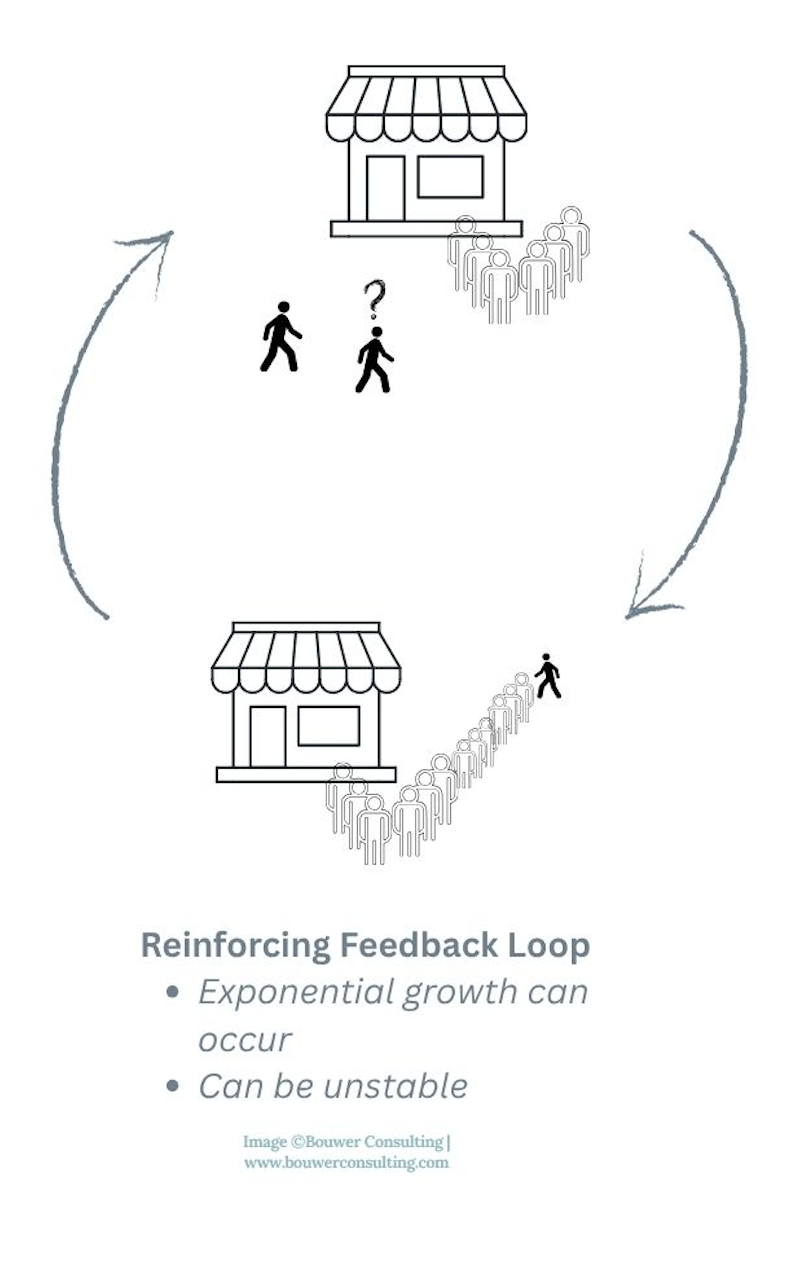
In this image you could say it’s a reinforcement feedback loop, otherwise known as a positive feedback loop. I see this one frequently in Asia- a long line outside a window makes you feel that you are missing out. Rather than miss out, you get in line and the line grows.
As someone walks by, they too feel they must be missing out due to the length of the line, so they also get in line. No one really knows why they’re standing there, but no one wants to miss out. What I have learned in Asia is, if it’s food related, it’s probably worth getting in line.
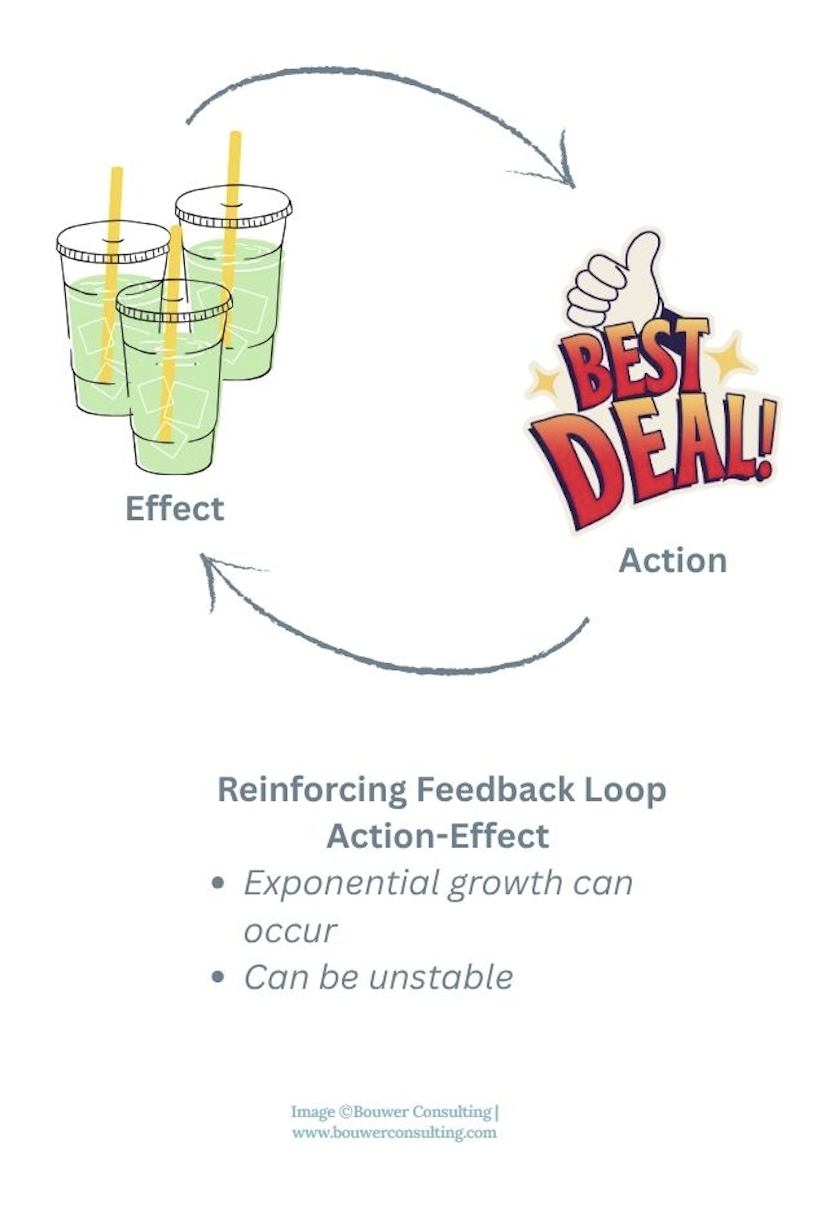
The second image is another type of reinforcement loop- action/ effect. For example, Meituan (our delivery app) ran a coupon campaign for tea shops to increase sales. The coupons were such that when you bought a tea (action), once the coupon was applied, the tea became free (effect). This caused a 3 day frenzy with tea shops around the city competing. ‘Sales’ were astronomical but there was no profit- just tired shop staff who couldn’t keep up with the amount of orders.
In the reinforcing feedback loop, exponential growth can take place because there are pressure points placed on the system that creates change. However, if not carefully controlled, instability often occurs. In the tea shop example, shop keepers had exponential growth in attracting new consumers, but it was very unstable. Once the coupons were discontinued, there was a crash in consumership.
Balancing Feedback Loop
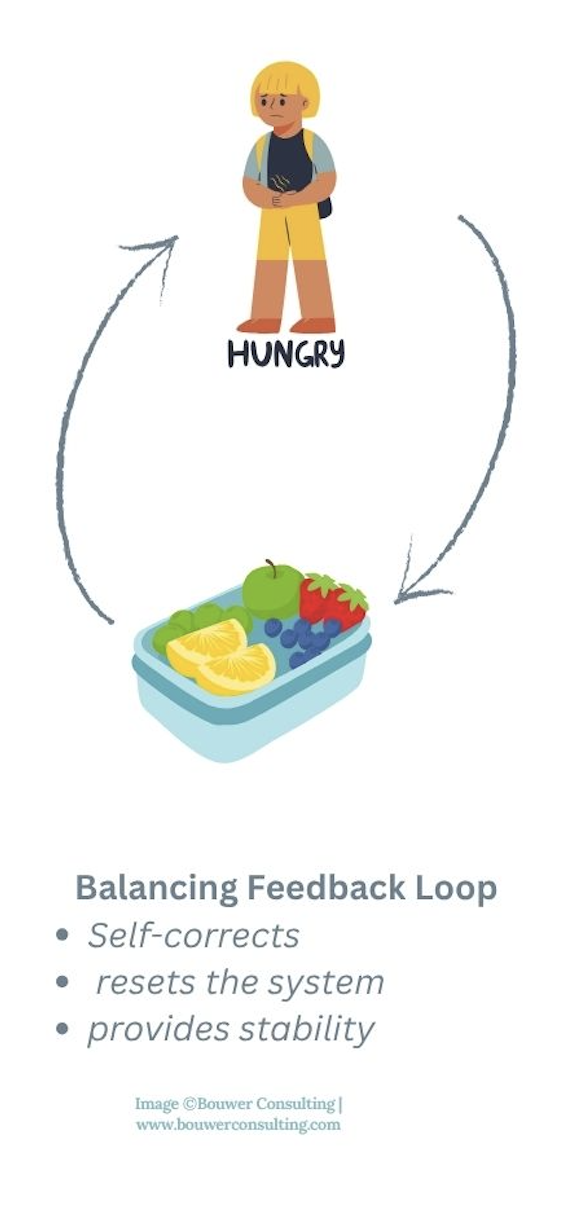
A second type of feedback look is the balancing loop or negative feedback loop. For example, I’m hungry, so I have a snack or eat lunch. In this feedback loop there is an attempt to counteract the change and reset the system to the starting point. There is a sense of stability as it often self-corrects.
Knowledge Cycle
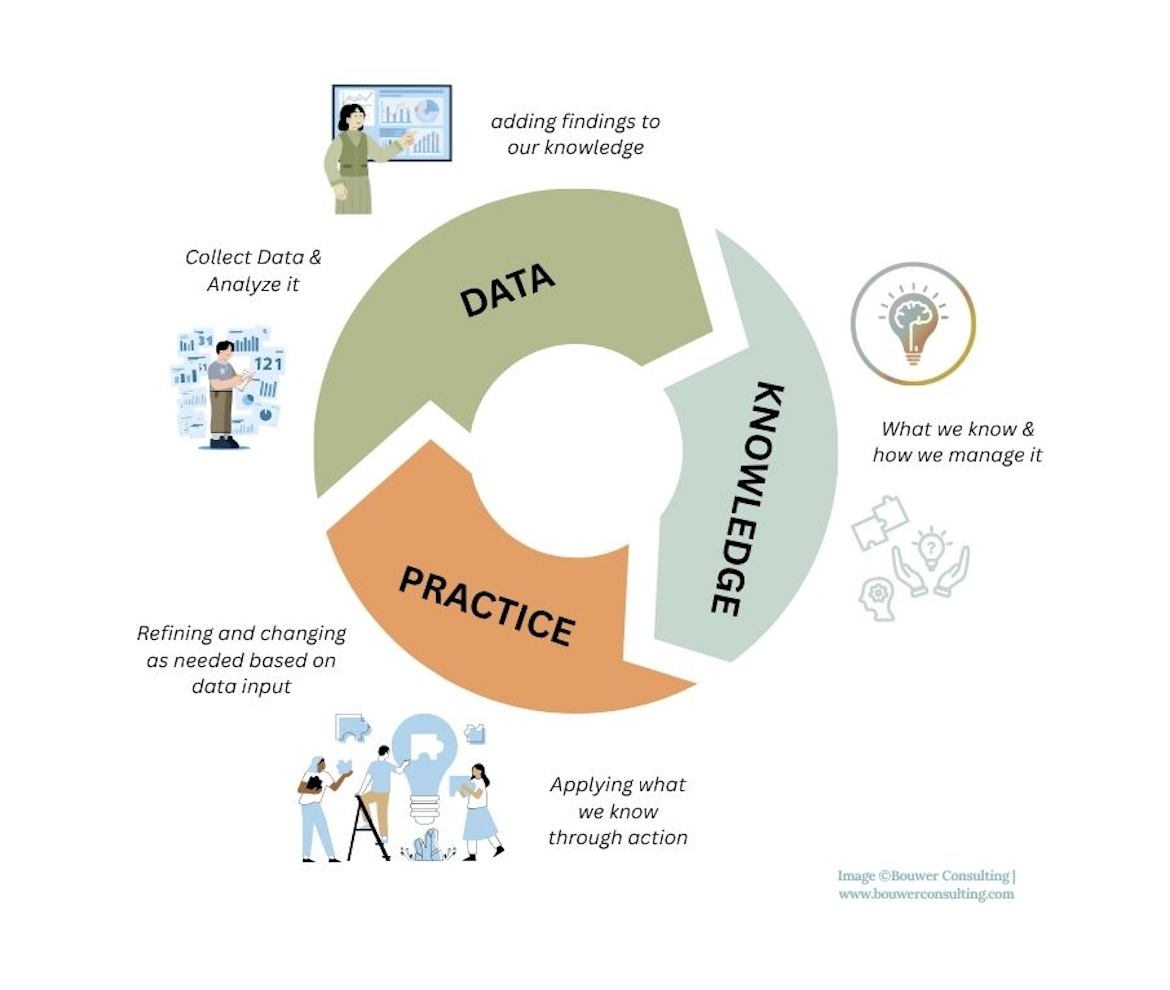
There is also a third type of feedback, the knowledge cycle. In program development, we do this frequently as we look to enhance the offerings we provide to our stakeholders.
In this feedback loop we have 3 components:
What we know- this leads us to making a decision for a practice or action we take.
As we practice and implement that action, we collect data.
Using that data, we analyze and interpret it to help guide our understanding and knowledge, which then influences our next practice with the goal of making improvements or changes.
Regardless of the type of feedback loop that you are using, Systems Thinking encourages organizations to look across the spectrum to identify what factors are being inputted into the loop which impacts the output.
4. Encourages Empathy
Particularly within education, NPOs, and Social Enterprises, empathy is often intertwined into the mission. Empathy is often defined as the ability to understand and share another individual’s feelings. With students and youth, we often talk about putting oneself in another person’s shoes to see from their perspective.
Systems Thinking naturally encourages the interpersonal relationships that are necessary to build empathy. Since Systems Thinking pulls into consideration various perspectives from all the different parts of the broader system, by design it forces individuals to take the time to learn about others’ experiences, challenges, and try to understand their viewpoint. As a result, this type of thinking naturally supports a culture where individuals can feel seen, valued, and understood because it provides a platform for all voices to be heard.

Final Thoughts…
Powerful collaboration is cultivated through a sense of shared identity and working towards a common goals. However, this does not happen instantaneously nor is it something that just occurs because it is a motto posted on a poster.
It requires intentionality.
It requires commitment to actively practicing the following:
Trust
Active Listening
Effective Communication
When these attributes are embedded into daily practice, teams will find that their collaboration skills move to a new level.
Are you or your team seeking to strengthen your collaboration? We work with teams to build alignment in understanding vision and develop stronger cohesion as they work towards a common goal. Contact us today for ways we can help guide you to use Systems Thinking to enhance your team’s efforts.
